- SalesDaily for Leaders
- Posts
- 🤖 How top leaders use AI SDRs
🤖 How top leaders use AI SDRs
Jason Lemkin, Aaron Ross, and Mark Roberge on rebuilding sales

Haris Halkic
November 23, 2025
In partnership with

Welcome to SalesDaily for Leaders: your weekly briefing packed with actionable insights to help you manage better, coach smarter, and drive results in B2B sales.
Every Sunday, we provide the latest strategies, resources, and ideas for leading high-performing teams and staying ahead in today’s competitive landscape.
Let’s dive in!
In today’s issue:
Jason Lemkin: What six months of AI SDRs actually looks like
Aaron Ross: Why copying Predictable Revenue failed
Mark Roberge: The 8 Stories I Tell Every Sales Leader
Matt Green: The 30-day pipeline experiment
Where sales teams win next year

2026 will reward teams that understand agentic systems.
This event shows what that looks like in practice.
→ AI handling sourcing and follow-up
→ Systems driving execution
→ Leaders rebuilding orgs around coordination
Quick, tactical, and free:
What six months of AI SDRs actually looks like
Jason Lemkin breaks down what happens when you deploy AI SDRs at scale, based on six months of real data and over $1M in closed revenue.
AI SDRs amplify what already works
They do not fix broken processes.
If your messaging fails with humans, AI will scale that failure.
Before deploying AI, you need:
Proven messaging that already converts
Clear ICP definition
Clean RevOps processes
Training based on real conversations that worked
↳ The AI can only repeat your best practices infinitely. You have to give it best practices first.
Human oversight is not optional
Expect 15-20 hours weekly managing these agents.
Performance rises and falls with human attention. Weeks with less oversight produce noticeably weaker results.
✔ Daily monitoring of outputs
✔ Weekly training updates
✔ Constant refinement of messaging
✔ Regular review of conversations and responses
↳ This is coaching five SDRs who never sleep. Not automation you can forget about.
Specialization beats all-in-one
Running five different AI agents trained for specific use cases outperforms one general tool.
Each agent gets completely different training:
Cold outbound to new prospects
Lapsed customer re-engagement
Active nurture for email openers who haven't converted
Inbound qualification on website
Ghosted lead recovery
↳ Specialized tools go deeper. Three A+ tools beat one B+ tool.
The outbound numbers
6.7% overall response rate. Industry average sits around 3%.
The AI sends more emails in one month than a human SDR sends in 40 months. With better response rates.
But results required massive human input. Sub-agents within outbound each had different training:
⇢ Lapsed sponsors: Reference past relationship
⇢ Current sponsors: Cross-sell to additional events
⇢ Previous attendees: Offer early access
⇢ Engaged non-converters: Follow up on email opens
⇢ Pure cold: Personalize based on company signals
Inbound AI changes meeting prep
Before each meeting, the AI provides complete context:
→ Full conversation history
→ Every page the prospect visited
→ How many times they engaged
→ Other people from their company who visited
→ Specific content they consumed
No more discovery calls. The AI already did discovery. Jump straight to solution discussions.
↳ In one month, 70% of closed revenue came through the AI SDR.
Direct selling on lower-ticket items
For products under $1,000, the AI can close deals without human involvement.
For higher ASP deals, it qualifies and books meetings. Then hands to humans.
The workflow that emerged:
Prospect asks for discount
AI gives discount code
Prospect leaves without buying
Day 3: AI follows up about unused code
Prospect converts
↳ 20% of ticket revenue now comes from AI agents selling directly.
Deliverability matters more than message
A 2-3 week warm-up period before sending at volume keeps emails hitting primary inbox.
Skip this step and your best message lands in spam.
Feed the AI fresh contacts
Upload new contact lists twice per week when possible.
About 90% of contacts should come from your own database. Not scraped from intent data providers.
↳ The AI performs better with fresh, trusted data.
The deployment playbook
Start with one agent and one use case. Get it working before adding a second.
Limit vendor selection to two maximum. Training ten vendors simultaneously means none get trained properly.
Begin in draft mode:
AI suggests messages
You approve and send
You correct and train constantly
After 30-60 days, start empowering for low-stakes interactions.
The common mistakes
✘ Expecting magic without putting in the work
✘ Deploying AI to fix what humans couldn't fix
✘ Generic training instead of specific proof points
✘ Set and forget instead of constant iteration
✘ Ignoring vendor expertise on platform best practices
👉 Power up your sales team

If you lead a sales team, run training sessions, or coach reps - this is for you.
With SalesDaily Elite, you get full white-label rights to my complete library of sales cheat sheets, guides, and templates.
✔️ Editable Canva files you can brand as your own
✔️ Ready-to-use for team onboarding, and workshops
✔️ Built for high-impact sales team enablement
Stop wasting time building resources from scratch.
Why copying Predictable Revenue failed
Aaron Ross, author of Predictable Revenue, reveals why most companies failed when copying his framework and what the future of B2B sales actually requires.
The framework got misunderstood
Companies copied tactics. SDR teams. Email cadences. Meeting quotas.
They bolted these onto commercial systems that were never designed to support them.
Marketing doesn't know what sales is learning. Customer success has no idea what was promised in the deal. Information dies in functional handoffs.
↳ Even Aaron admits the market got it wrong. The book wasn't really about outbound prospecting.
Tactics without architecture creates activity, not outcomes
You can nail the sales execution and still plateau.
The commercial system underneath is the problem. When SDRs learn what messaging works, does that intelligence reach marketing? Or does it depend on someone remembering to mention it in a meeting?
When sales closes deals with specific buyer profiles, does outbound adjust targeting? Or do they keep prospecting the old ICP because intelligence never flows back?
↳ No amount of better SDR coaching fixes structural dysfunction.
What happens when information gets trapped
SDRs prospect. They learn what messaging lands. Which verticals buy. What objections surface.
That's market validation happening in real time.
In most companies, that intelligence dies in the sales silo.
→ Marketing keeps running the same campaigns → The next SDR hired learns the same lessons from scratch → CS has no idea what was promised during prospecting
The metric that changes everything
Old approach: Measure meetings booked.
New approach: Measure market intelligence captured.
When SDRs get measured on meetings, they push conversations toward artificial urgency. When they get measured on intelligence, they have permission to be curious instead of aggressive.
Joey Gilkey runs SDR teams where the North Star is market intelligence captured, not meetings booked.
His SDRs catalogue after every call:
What messaging landed
Where the prospect is in their buying process
What objections surfaced
Which competitors they're evaluating
↳ That intelligence flows back to AEs for deal strategy. It flows to marketing for campaign adjustments. The system gets smarter, not just busier.
Sales as a communication channel
Most companies see sales as closers. They miss the bigger opportunity.
Sales teams have live conversations with buyers every day. They're learning what works. What objections matter. What timing looks like. Which competitors are in play.
That intelligence is more valuable than any intent platform or survey.
But it gets trapped in individual reps' heads because nobody measures it.
Aaron's take:
⇢ You can't learn what surveys, polls, and market research can't capture ⇢ Live conversations produce insights automation never will ⇢ Companies do not take advantage of this
Human-led beats automation
After fifteen years watching companies try to automate their way to predictable revenue, Aaron's advice: have more conversations.
Not sales conversations. Validation conversations.
✔ Learning what buyers actually care about ✔ Understanding timing without forcing it ✔ Capturing competitive intel without pitching
The future isn't choosing between human and automation. It's humans doing what only humans can do, supported by systems that distribute what those humans learn.
What's actually durable
Tactics change. Tools change. What survives?
Relationships. Creativity. Intuition.
Aaron referenced Colombo, the TV detective who acted dumb and asked curious questions instead of coming in hard. That approach builds relationships. Disarming curiosity. Operating on the buyer's timeline.
↳ The predictable revenue framework got weaponized into aggressive prospecting. What actually works is the opposite.
The diagnostic questions
Before implementing any GTM framework, assess whether your commercial architecture can support it.
Ask:
When SDRs learn what messaging works, does that intelligence systematically reach marketing?
When sales closes deals, does outbound adjust targeting based on what's actually working?
When CS identifies which customers expand or churn, do SDRs prioritize account types that match expansion patterns?
If the answer is no systematic flow, you have an architecture problem. Not an execution problem.
Partnering with:
Navan: The leading travel and expense platform
Smartlead: Automate outreach without losing the human touch
Close: Manage relationships and scale outreach in one smart CRM
La Growth Machine: Multichannel prospecting that actually scales
(include affiliate links)
The 8 stories I tell every sales leader
Mark Roberge compiles lessons from scaling HubSpot's sales team and teaching at Harvard Business School.
Walk in the buyer's shoes
HubSpot's sales training had new reps start their own blogs. They wrote 15-20 posts. Set up landing pages. Experienced exactly what they'd ask prospects to do.
When a buyer said "what if my writing is bad?" the rep could say "I just went through that."
The 30-page diagnosis
One rep had a territory of two accounts. His job: convert Target from Oracle to Salesforce.
He didn't call them for two months.
Instead, he shopped at Target every day. Screenshotted every email. Built a 30-page diagnosis of their marketing strategy. Mailed 25 copies to every digital marketing executive.
Within three days, meetings with all of them.
There is no universal amazing salesperson
Roberge hired the #1 rep from an 800-person team. Six months later, middle of the road.
That rep came from a 20-year-old company running Super Bowl ads. Prospects knew what was coming.
HubSpot was year one. "What is inbound marketing?"
↳ There's only optimal for your context.
Comp plans at product-market fit stage
Founders copy enterprise comp structures. Commission based on revenue.
Completely misaligned.
At product-market fit stage, you need 20 very healthy customers. Not maximum revenue.
Commission on revenue incentivizes the opposite behavior.
Expansion without experimentation
Q4. Founder does the math. ICP only gets them to 7M, need 9M.
So they commit to the board: "We'll launch Europe and get 2M from there."
They've never sold a single deal in Europe.
The fix: Run 10% experiments on expansion while scaling 90% into known ICP. Put a rep in Europe a year before you need the revenue.
TO-GO
Matt Green: The 30-day pipeline experiment
Marcus Chan: I used to give feedback all wrong
Mike Groeneveld: Kickoffs don’t build culture
Dan Richards: Run a great sales interview process
QUOTE OF THE DAY
"Activity without strategy is just movement."
PODCASTS

HUMOR
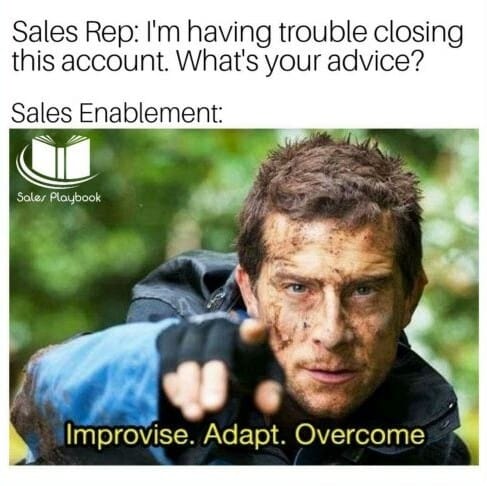
@saleshumorhq #SalesTok #FunnySales #BizHumor #SalesLife #CorporateComedy